
OmniAI Group of ZJU ACES Lab
Spatial-Interactor

Learning Spatial Reasoning through Interaction
with the Observable Physical World
1 Zhejiang University2 SAP* Equal contribution
 Paper
Paper Code
Code Dataset
 Models
01 / Motivation
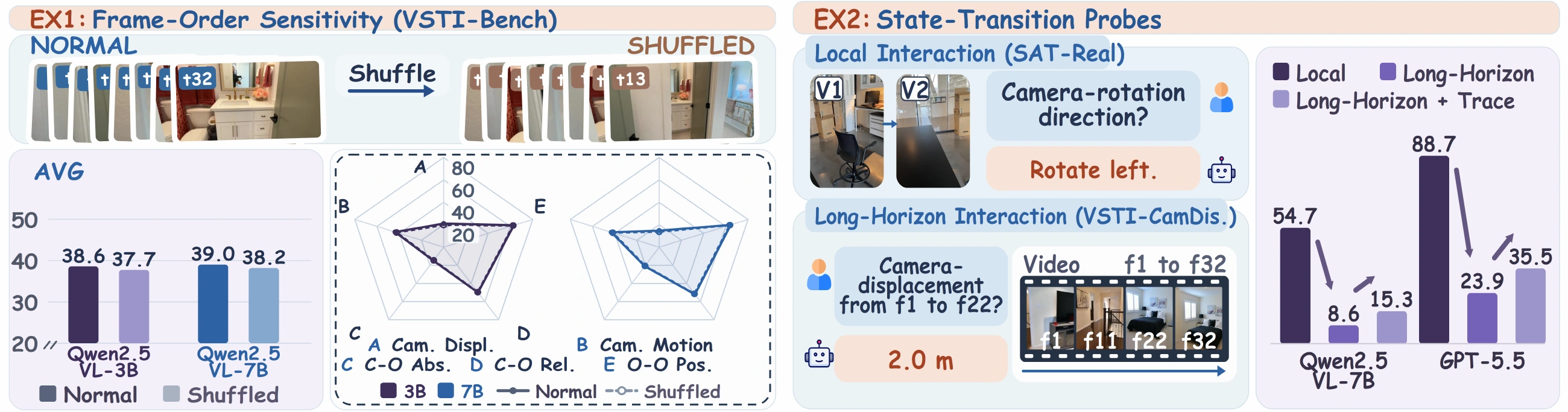
State-transition diagnostics reveal the missing capability
Frame shuffling exposes weak temporal-order sensitivity, while a local-to-long-horizon comparison shows that models struggle to integrate consecutive transitions over complete trajectories.
02 / State-Transition Learning
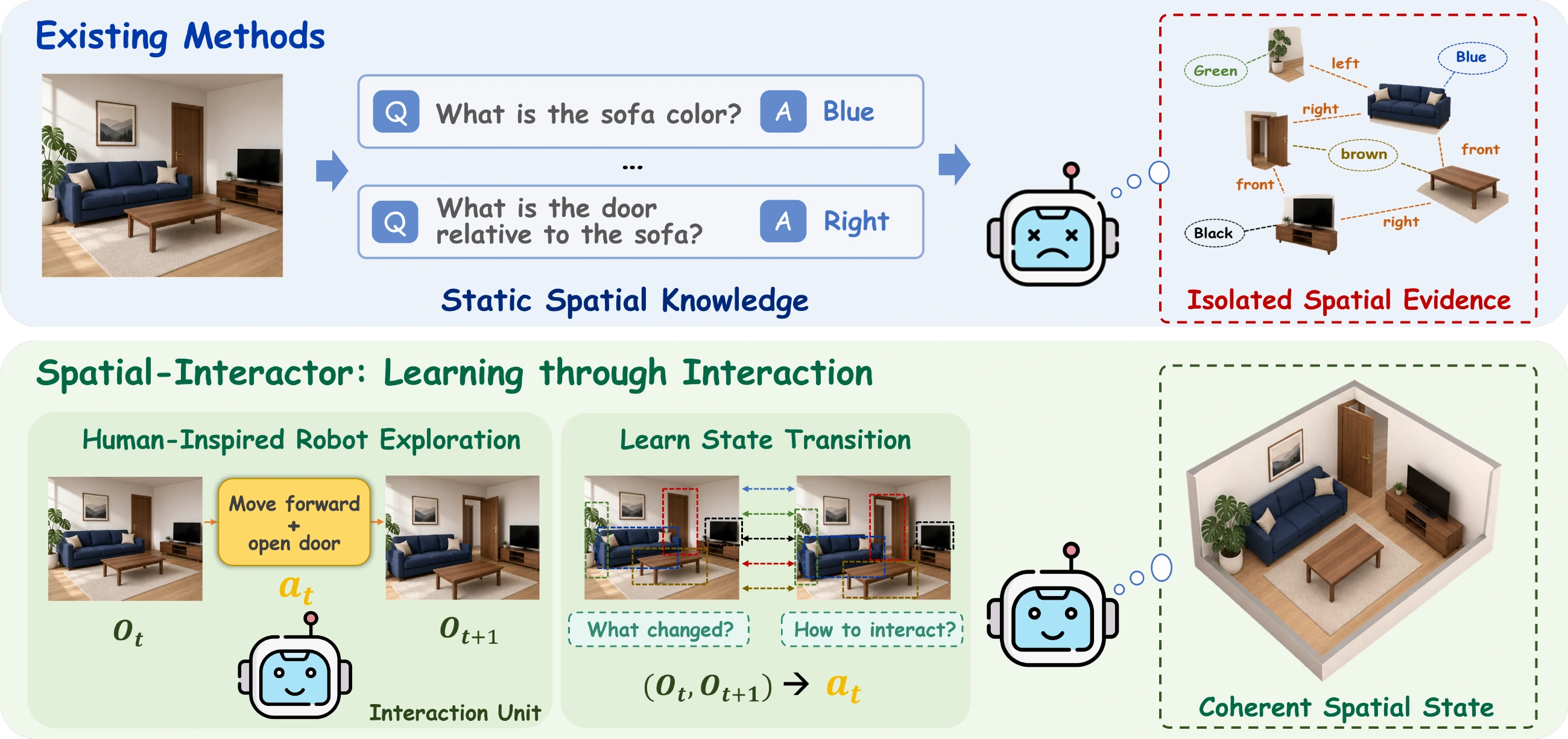
Learning physical-world state transitions through interaction
Each interaction aligns consecutive observations with the physical change that connects them. Individual records support local transition inference; ordered trajectories support trajectory-level reasoning.
03 / Curriculum-Driven Construction
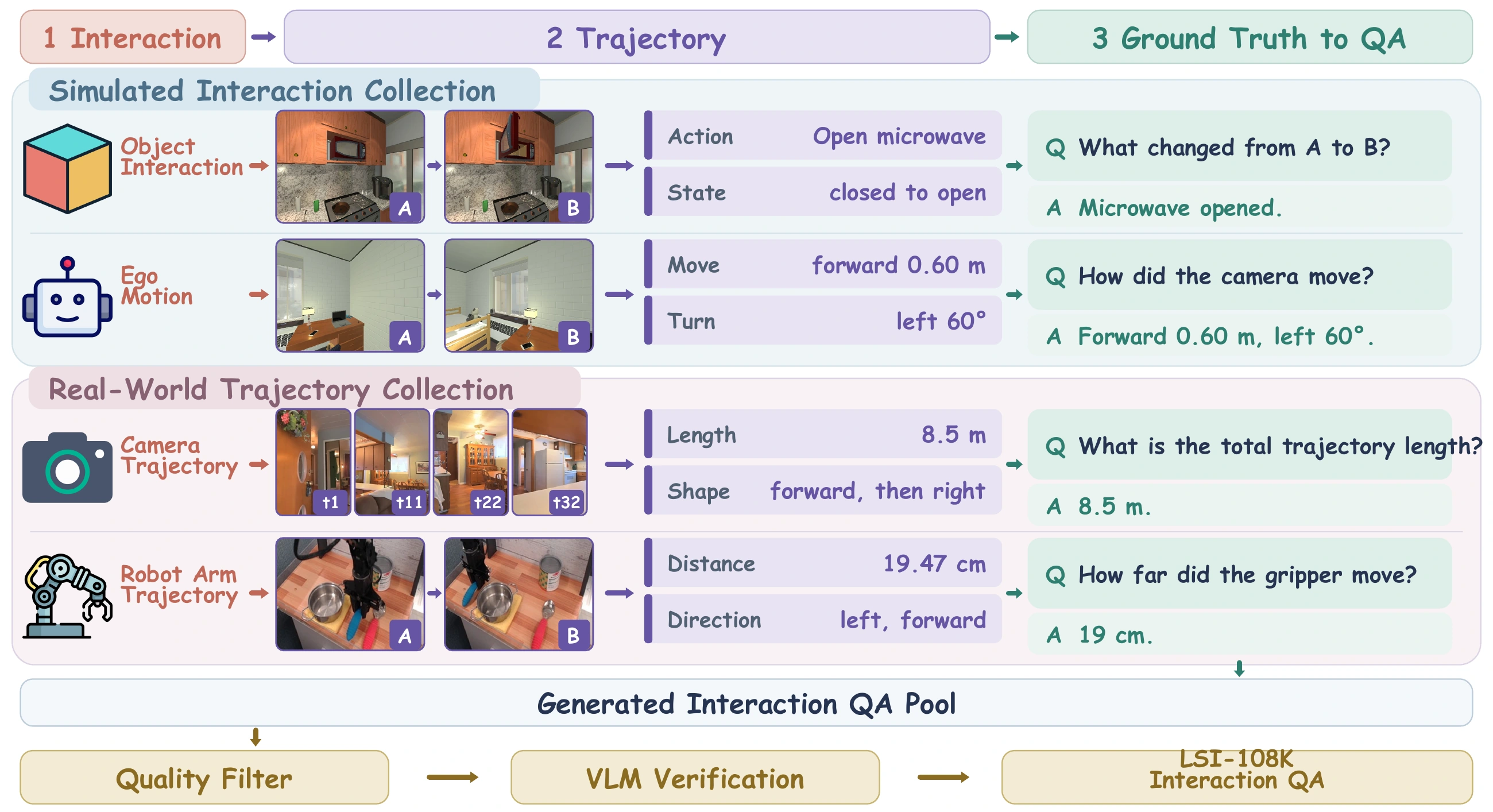
From interaction records to verifiable transition targets
Executed interactions and geometric trajectories provide the state changes. State, pose, and trajectory metadata determine the targets, which deterministic templates render as QA pairs.
04 / Progressive Curriculum
A progressive spatial interaction curriculum
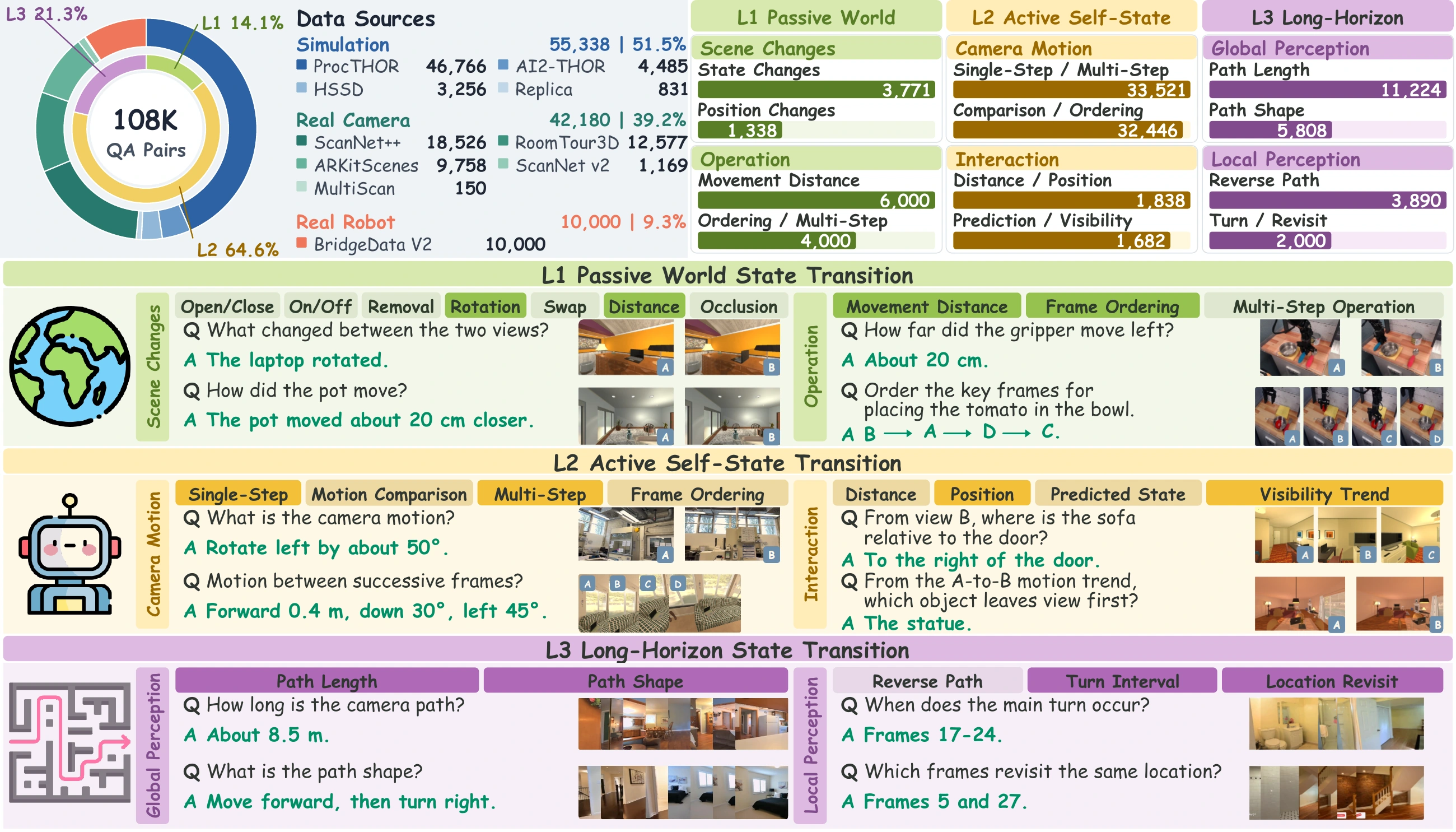
We organize supervision by the state being updated and the horizon of that update: L1 isolates external-world changes, L2 models observer-induced changes, and L3 composes successive transitions over complete trajectories.
Passive world-state transitions
The world changes; the viewpoint stays approximately fixed. Learn object motion, state changes, and single- or multi-step operations.
15,109 QA pairs
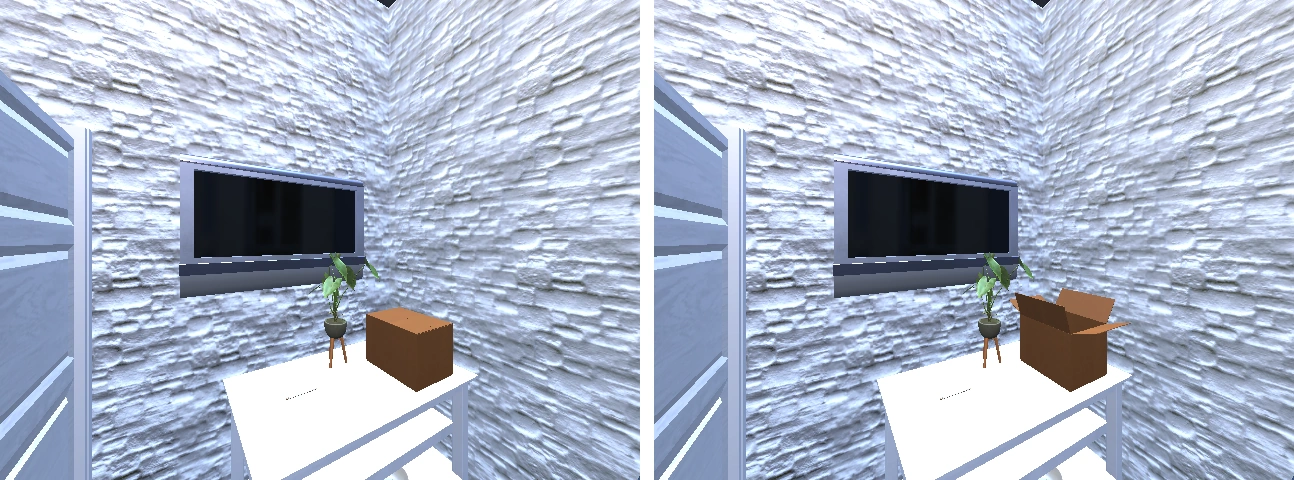
Question
What state change occurred between the two views?
Reference answer

C. An object was opened or closed.
Composition of LSI-108K
05 / Training
From local state-transition modeling to long-horizon integration
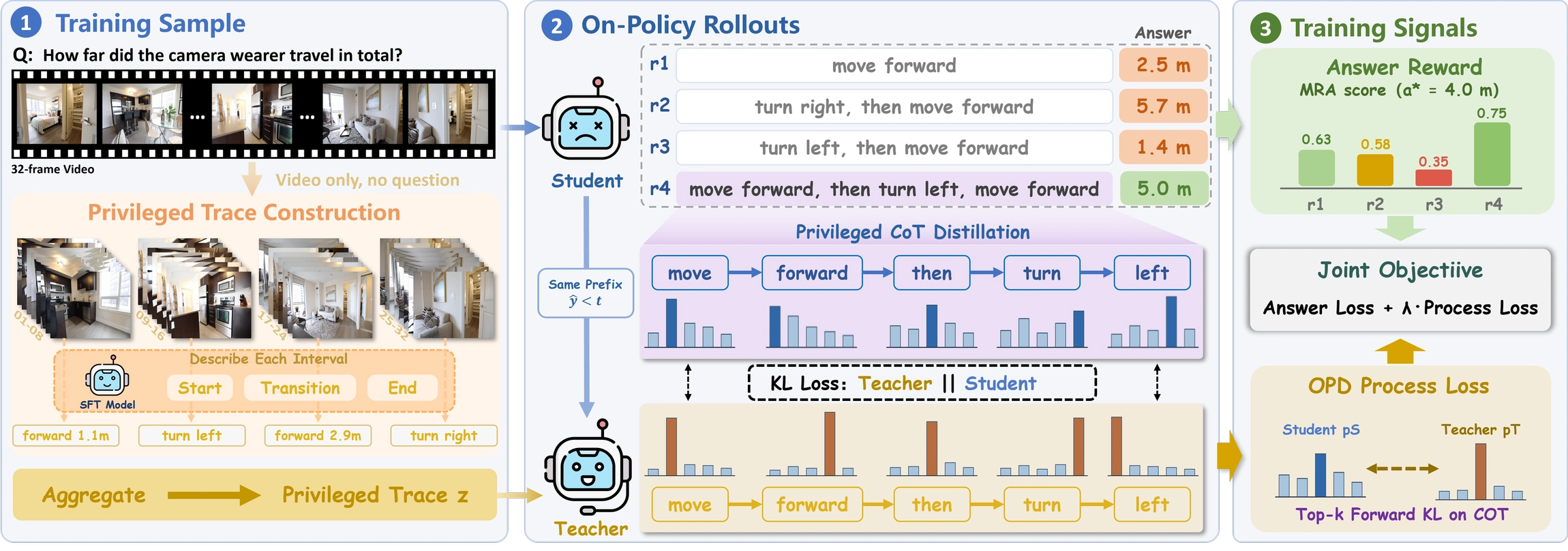
SFT learns world-state and self-state transitions from L1 and L2. OPD then uses privileged process supervision to integrate successive transitions over long trajectories.
Stage 1 L1 + L2
Local State-Transition Modeling
Associate differences between observations with object operations and ego-motion, learning reusable local state-transition representations.

Stage 2 L3
Long-Horizon Integration with OPD
Use training-only transition descriptions to guide reasoning over complete trajectories, alongside verifiable final-answer rewards.
06 / Main Results
Learning from interaction improves spatial reasoning
Across four backbones, Spatial-Interactor improves spatial relations, multi-view reasoning, and tasks that integrate motion evidence over longer trajectories.
Cross-benchmark generalization
Ablation studies
07 / Process and Temporal Analysis
Process dynamics and temporal evidence
Curriculum ablations, OPD optimization dynamics, and temporal diagnostics examine how answer performance and process alignment change during training.
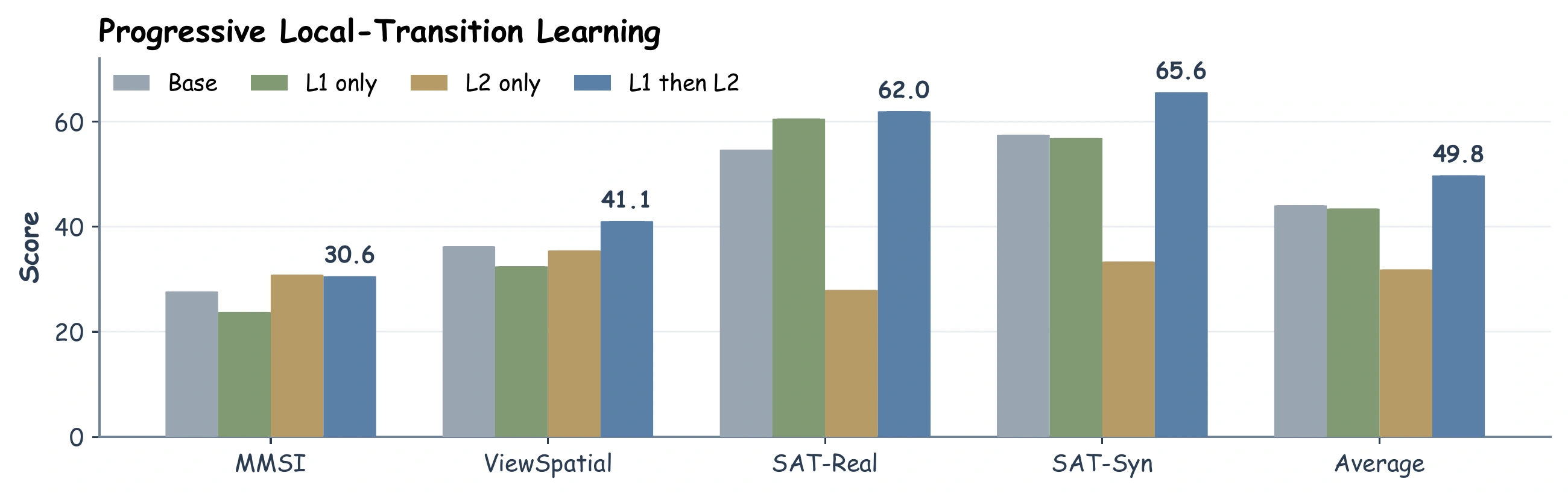
Progressive local-transition learning
L1 and L2 contribute differently. Training them in sequence improves all four benchmarks over Base.
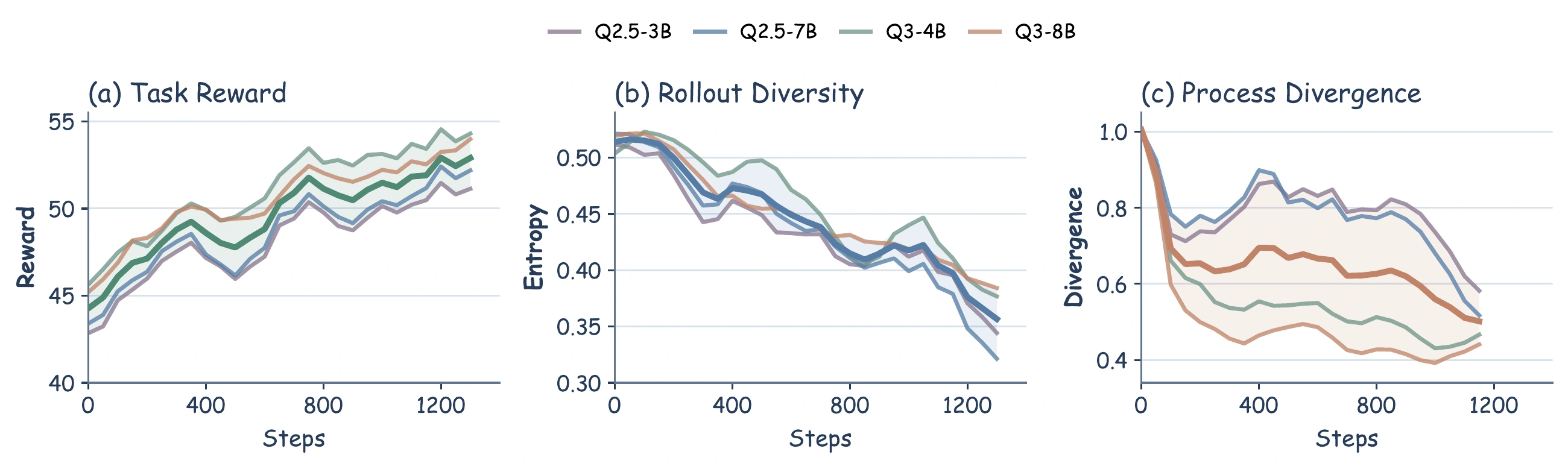
OPD optimization dynamics
Across four backbones, task reward rises, rollout diversity gradually narrows, and divergence from the privileged teacher decreases.
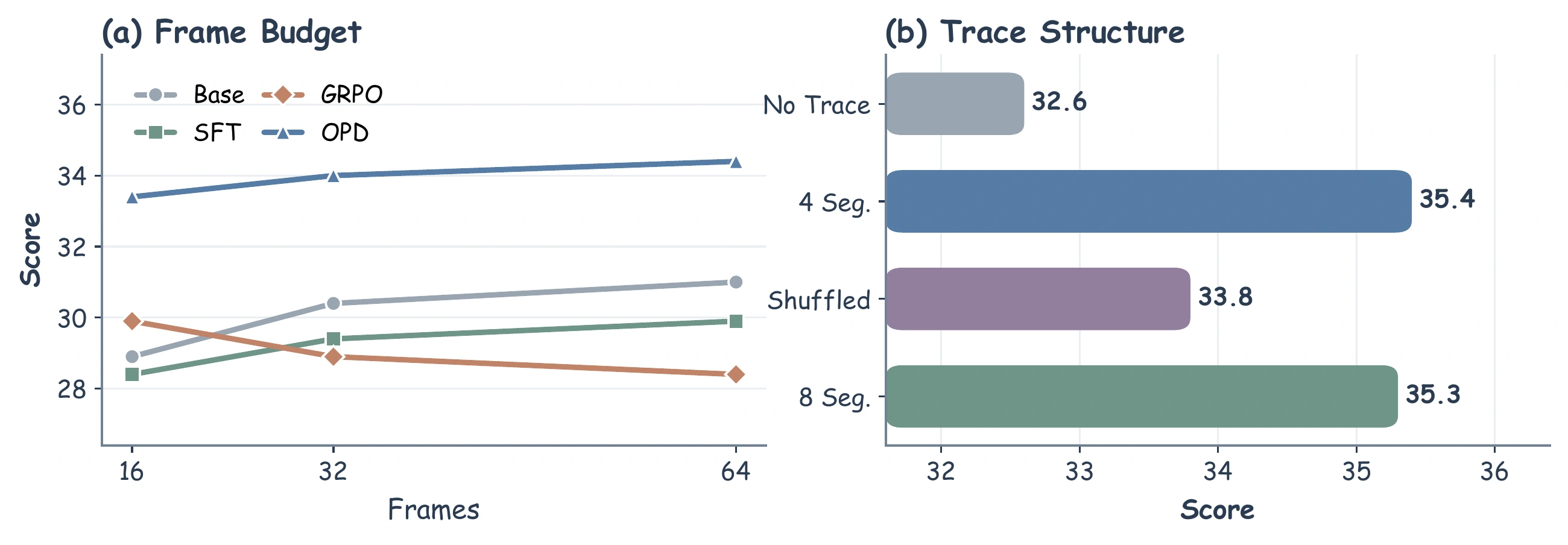
Temporal evidence and privileged-trace diagnostics
OPD retains its advantage across frame budgets. For the frozen SFT model, ordered segment descriptions help more than shuffled descriptions.
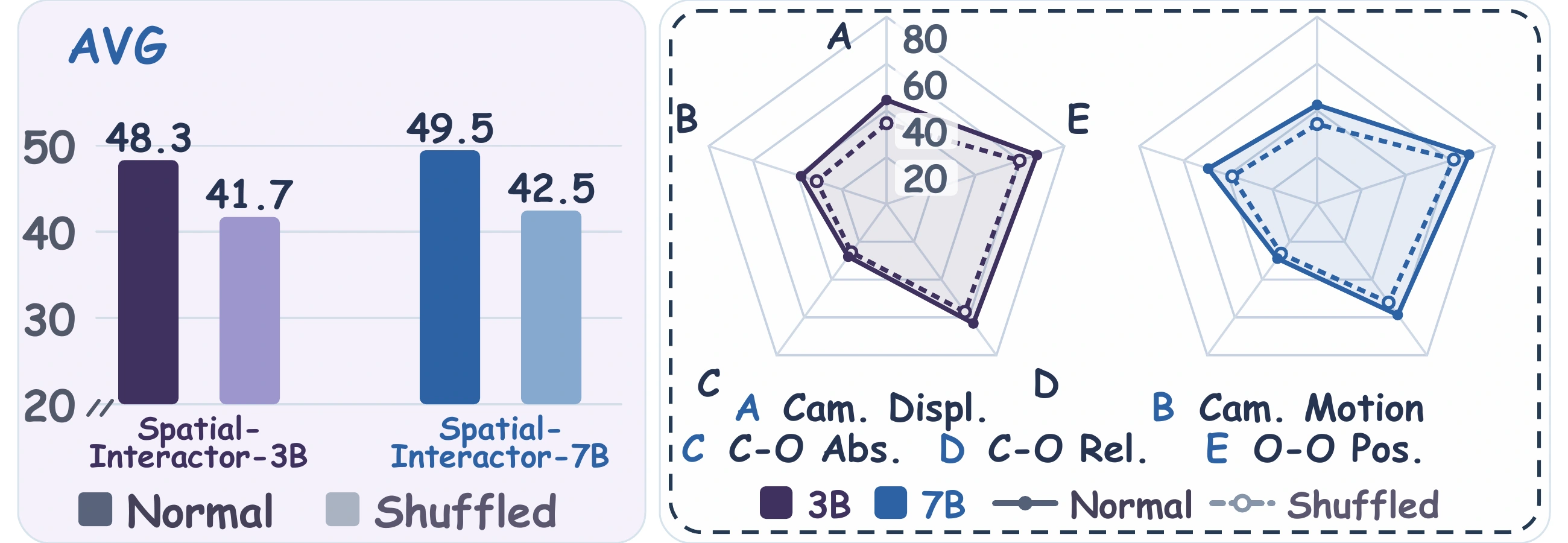
Frame-order sensitivity
Shuffling identical frames reduces Spatial-Interactor scores by 6.6 and 7.0 points, compared with 0.9 and 0.8 for the corresponding Base models.
08 / Closed-Loop Interaction
Spatial reasoning under changing observations
The same spatial updates support repeated decisions when each action changes what the model observes next.
WalkerBench
ESI-Bench
09 / Qualitative Analysis
Spatial reasoning across views and trajectories
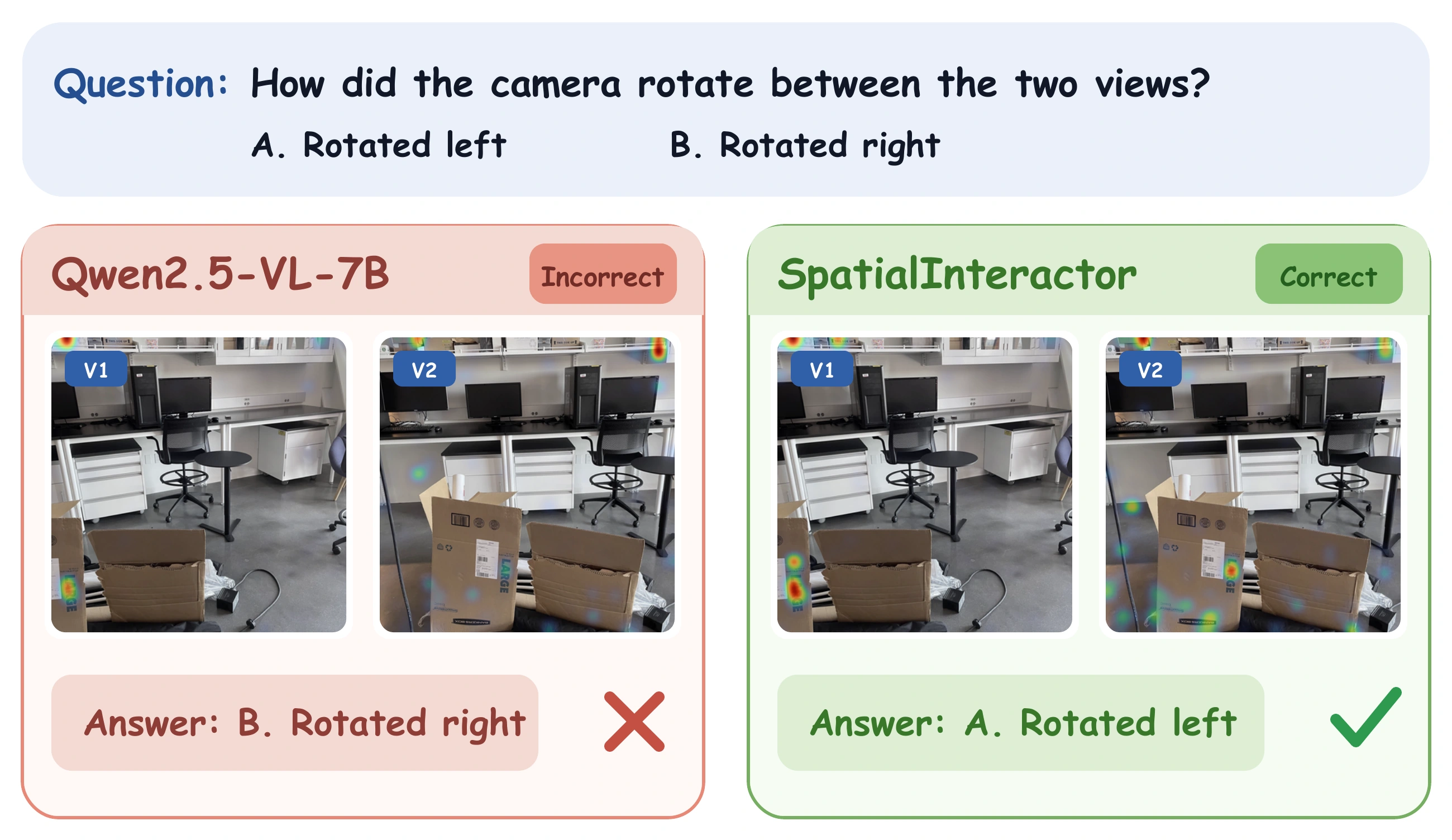
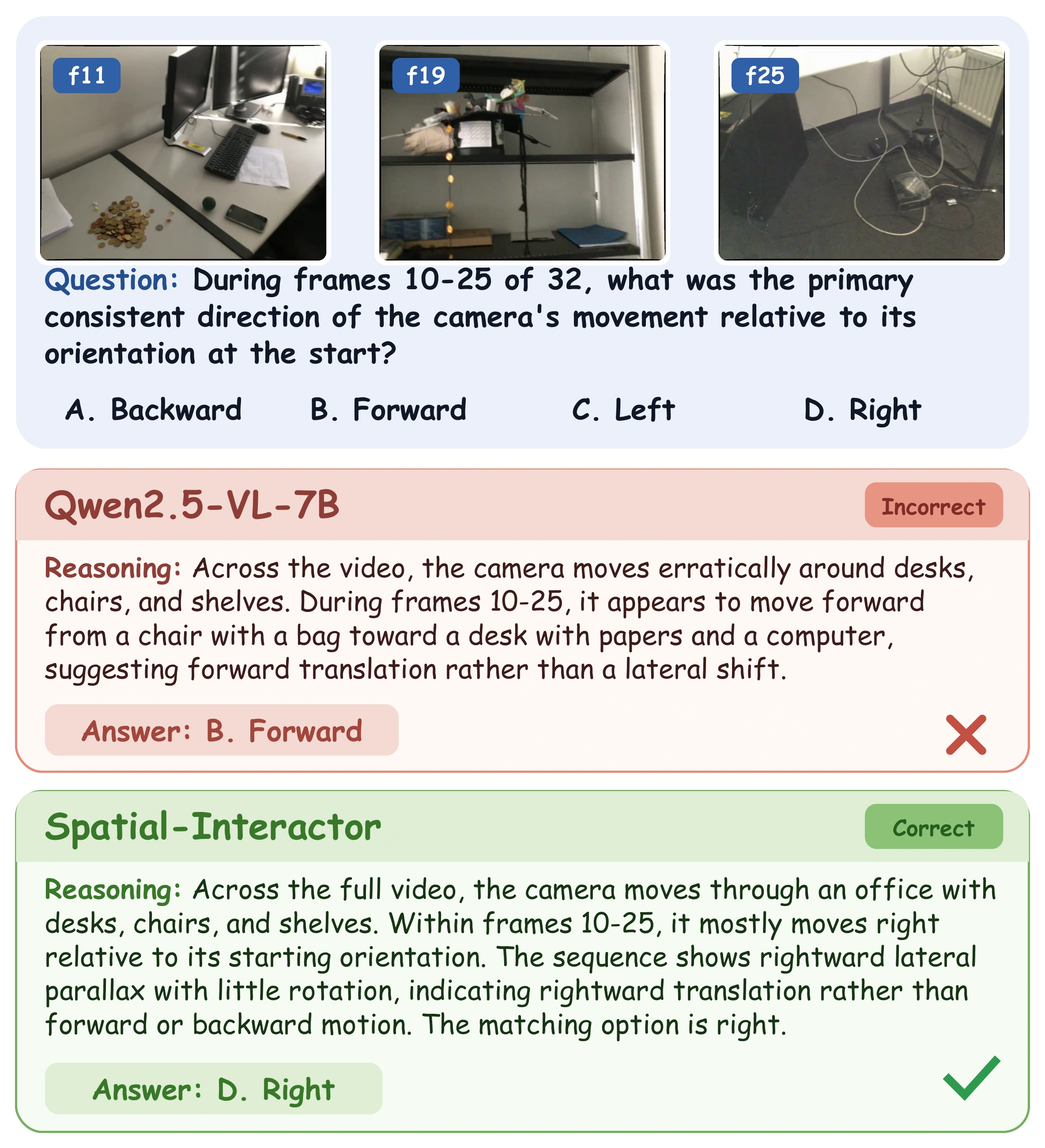
A shared anchor resolves a local viewpoint change; ordered landmarks recover motion across a longer trajectory.
Cross-view anchor correspondence
Long-horizon trajectory integration
Citation
Spatial-Interactor
Learning Spatial Reasoning through Interaction with the Observable Physical World
Read the paper
@misc{yao2026spatialinteractor,
  title = {Spatial-Interactor: Learning Spatial Reasoning
           through Interaction with the Observable
           Physical World},
  author = {Yao, Kaixiang and Wang, Xu and Pan, Miao
            and Hu, Xiyue and Wang, Weishi
            and Dahlmeier, Daniel and Chen, Jintao
            and Shen, Yongliang and Zhang, Xuhong
            and Zhang, Wenqi},
  year = {2026},
  note = {Preprint}
}